Thursday, October 20, 2016

Mike D Wim Wenders

Wim Wenders is a German photographer, among other things such as author and filmmaker, that was born in Dusseldorf in 1945. At a young age he would frequently take trips by himself to Amsterdam's Rijksmuseum. He eventually go on to study medicine and philosophy in Germany only to drop out and move to Paris to become a painter, and when things didn't pan out like he planned he became an engraver. It was during his time as an engraver that he became fascinated by films. So much so that he went back and went to school at the University of Television and Film in Munich. Alongside film he works with photography by portraying desolate landscapes. Many of his themes include time, loss, memory, and nostalgia. He has since become an avid traveler of the globe to take pictures that capture certain moments, places, or space.

Here we have a picture of a group of chairs set up in front of a stage. It definitely goes along with his theme of desolation.
This picture is showing the empty corner of a street. It kind of gives off an eerie feel to it as you wouldn't think that a street corner and the shop on the corner would look this empty.
This picture of the Coke machine, I feel, goes along with his theme of nostalgia because it is definitely an old machine inside of what seems to be an older building and many people have a connection to when they were young and some of their first sodas somewhere
This picture I found interesting because it differs from his other pictures by having people in. This picture presents a police officer standing watch over a field while people are moving through the field. Where and in what context this picture was taken is beyond me, but I still find it interesting because it differs from his other pictures
In what seems to be another abandoned town we can see the remains of a decaying billboard along with some cars and a slight view down the street. The look of the sky makes me think that this picture goes with his themes of loss and memory

Sophie


Steve McCurry is an American photographer that has worked in photojournalism and editorial. He is best known for his 1984 photograph "Afghan Girl" which originally appeared in National Geographic magazine.

McCurry focused on the human consequences of war, intending to not only show what war impresses on the landscape, but rather, on the human face. “Most of my images are grounded in people. I look for the unguarded moment, the essential soul peeking out, experience etched on a person’s face. I try to convey what it is like to be that person, a person caught in a broader landscape, that you could call the human condition.”


Sophie


Flavia - Jeff Wall


JEFF WALL


Jeffrey "Jeff" Wall, OC, RSA (born September 29, 1946) is a Canadian artist best known for his large-scale back-lit cibachrome photographs and art history writing. Wall has been a key figure in Vancouver's art scene since the early-1970s. Early in his career, he helped define the Vancouver School and he has published essays on the work of his colleagues and fellows. (Vancouver School:  photographs of high intensity and complex content that probed, obliquely or directly, the social force of imagery. No formal "school" exists and the grouping remains both informal and often controversial even amongst the artists themselves, who often resist the term).
Wall was influenced by
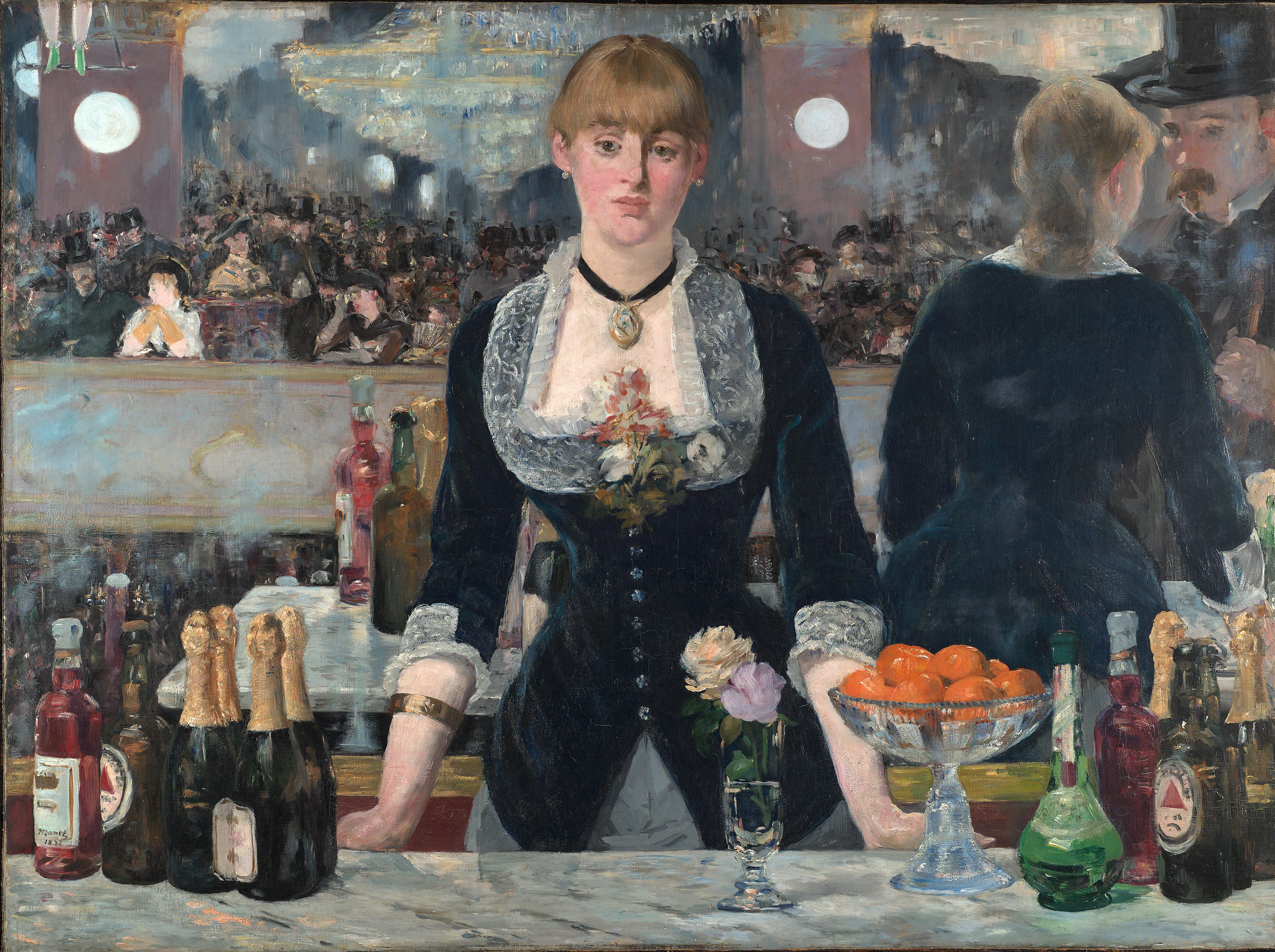
Manet, Velazquez, Hokusai, Kafka, Mishima, Delacroix, Ellison, and according to Susan Sontag (Regarding the Pain of Others) he was also influenced by Goya when making Dead Troops Talk.
Wall can be considered as a modern Pictorialist photographer (like Stieglitz) as his works are mainly constructed, consciously set up to show a theatrical and dramatic scenes, precisely like in the case of Dead Troops Talk. Even works such as Destroyed Room and A Sudden Gust of Wind are entirely set, designed, organized, and inspired by previous artworks, such as Hokusai.
Wall has created works that locate their action at the threshold between the self-evident and the nonsensical, seeking to enrich and expand our attention toward the specific properties of photographic experience. His gnomic titles and deceptively straightforward compositions combine to raise a multitude of questions, for which the recalcitrant stillness of a photograph can provide no conclusive answer.
“In my time, I’ve been accused of being afraid to go out into the world to take pictures, like a so-called ‘real’ photographer does, and I’ve been accused of making art with a capital A – as if that, too, was a crime.” Jeff Wall.
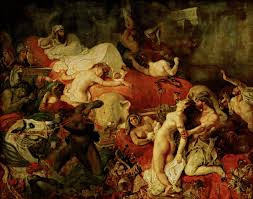
In 1978, he exhibited The Destroyed Room in the window of the Nova Gallery in his home town Vancouver. Inspired by Delacroix’s painting The Death of Sardanapalus (1827), it showed a spectacularly dishevelled bedroom that was like the scene of a violent row or a crime, with clothes scattered everywhere and the furniture, doors and walls destroyed. Back then, inspired by garishly backlit street adverts he saw at bus stops in Madrid while returning from the Prado, his colour transparencies were meticulously choreographed and mounted in vast light-boxes.
Image result
Jeff Wall, Dead Troops Talk, 1992
Image result for jeff wall a sudden gust of wind
Hokusai, Travelers caught in a sudden breeze at Ejiri, 1832
Image result for jeff wall a sudden gust of wind
Jeff Wall, A Sudden Gust of Wind, 1993


Image resultImage result for jeff wall destroyed room
Delacroix, The Death of Sardanapulus, 1827                                                               Jeff Wall, Destroyed Room, 1978


Image result for jeff wall picture for women
Jeff Wall, Picture for Women, 1979


Image result for jeff wall picture for women
Edouard Manet, Un bar delle Folies Bergere, 1881


Image result for jeff wall
Jeff Wall, Milk, 1984


John Frazier

Margaret Bourke-White; June 14, 1904 – August 27, 1971) was an American photographer and documentary photographer. She is best known as the first foreign photographer permitted to take pictures ofSoviet industry, the firsthand American female war photojournalist, and the first female photographer for Henry Luce's Life magazine, where her photograph appeared on the first cover. She died of Parkinson's disease about eighteen years after she developed her first symptoms.


This picture does a great job of including several iconic images. It includes the Coca Cola logo and old post logo and a giant Hot Dogs logo. I really love this picture and it perfectly sums up Margaret as a photographer.


This image is another example of Margaret adding people with iconic images in the background I really like the way the people are lined up in relation to the phrase There's no way like the American Way and the facial expressions used by the people in the image.

This is a very dramatic image the person is placed perfectly to show the sorrow which makes this a very powerful image.

I had a hard time trying to come up with the words to describe this image. The choice of lighting makes the man really stand out compared to the dark images surrounding him.

I also really liked the lighting and shadows used in this image and how they contrast each other it really makes the child and the barbed wire pop out from the background.

Marissa: August Sander

August Sander: Sander was a German photographer born in 1876 and died in 1964. Born in Herdorf, Sander worked in a local mine where he first came in contact with photography by acting as an assistant to a photographer who was working for the mine. With a sparked interest, he bought some photography equipment and created his own darkroom. From 1897-99, he spent his military service as a photographer's assistant then traveled around Germany taking pictures. He soon came across the Cologne Progressives, a radical group of artists linked to the workers' movement. From there, he began his project of People of the 20th Century and began taking portraits of working men and women. In 1929, Sanders Face of Our Time was published containing many of these portraits, however, he came across tough times with the rise of the Nazi party, and soon all his work was destroyed. 

 
This photograph depicts a portrait of a brick mason, carrying a load of bricks on his shoulders by the support of a wooden plank. The subject is centered, and is looking intently as the viewer, almost as though he is posing. These seems to be no motion in this photo, and the subject seems to be standing still for the photographer. The black background provides nice contrast to the grey colors of his clothing and skin.

This photograph is a portrait of hat seems to be a chef or a baker. Again, the subject is centered and is looking directly at the viewer, almost motionless. The man's white kitchen attire is a nice contrast to the darker surroundings. There also seems to be a relatively high aperture as the background appears blurry.
This photography is a portrait of a man standing on the sidewalk in winter attire, fully covered. Again, he is looking directly and seriously at the viewer, as well as motionless. This subject does not seem to be exactly centered, but rather to the right a little, creating a nice vertical line. There is another diagonal line following the curving path of the street that again directs the eye closer to his face.
This photograph is a portrait of what seems to be two athletes. Both directly looking at the viewer and motionless, the photo seems to be posed. Both provide two vertical lines and one is slightly taller than the other. The contrast between their black clothing and their pale skin and lighter background is very attracting to the eye.
This photograph is a portrait of a woman leaning up against a trailer, possibly as part of a circus. Again, she is motionless and looking directly at the viewer. She acts as a centered vertical line, and the edge of the trailer also acts as a horizontal line through the center of the picture. Again, the contrast between white and black is also very eye-catching.
This photograph is a portrait of two young children holding hands in the center of the frame, both motionless and looking directly at the viewer. There is a high aperture in this photo as seen through the blurred background. The lines of the doors behind them acts as nice vertical lines corresponding with the children. The contrast between their clothes and skin against the background is also very eye-catching.

Wednesday, October 19, 2016

Gianni Berengo Gardin - Sami


Gianni Berengo Gardin is a photographer from Italy, born in 1930. He didn't pick up photography until 1954. At one point in his life, he lived in Paris and simply taught himself the basics of photography while working with other local photographers. He enjoys representing individuals' day-to-day activity that show the flow of society. Specifically, he focuses on reportage and editorial work.


This photo directs the attention to the two people walking in the street very well. There is a very good distinction between where the trees are and where the people are.


This photo shows the playfulness of children in a city. The sign with the right arrow offsets the trolley a little bit but the fact that there are cars shown on either side of it focus the attention right to the trolley with the children on the back.


This photo shows different levels of people, forcing you to look at the whole picture rather than a specific point of interest. These people seem to be having some sort of dance off while their friends watch.


This is another photo that shows the simplicity of youth. These kids all seem to be having a great time with each other simply by playing jumprope. The rope and the girl's legs in the middle are both in motion, but that helps the photo to capture the true essence of the game.


This is a photo that has a very central focus. Everything is lined up perfectly to the middle, except for the two blurry birds in the left corner.


This seems to be a street performer caught right at the perfect moment. Because of the fact that he is in motion and everything else is focused, it allows the focus of the photo to still be on him. The lining of the concrete also draws the eyes right to the person rather than to the buildings on the side.